 POSTER
Free When to Wash Hands Poster Guide
Master kitchen hand hygiene triggers under UK food safety laws. Free food service handwashing poster covering raw meat handling, bins, and coughs.
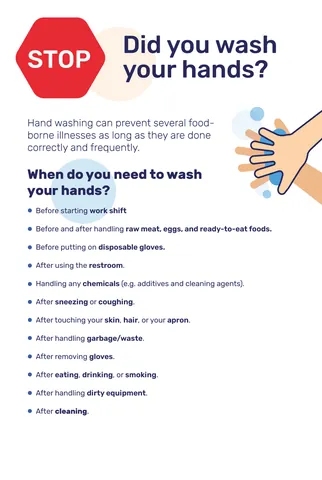
Under UK Food Safety Regulation (EC) No 852/2004 and FSA guidelines, commercial food handlers must wash their hands frequently and thoroughly with warm running water and antibacterial soap (BS EN 1499). Mandatory triggers include: before starting food prep, immediately after handling raw meats, poultry, or eggs, after visiting the toilet, after touching waste bins, after coughing, sneezing, or blowing your nose, after touching your face or hair, between handling allergen and non-allergen foods, and before donning disposable gloves.
Commercial Kitchen Handwashing Poster & 20-Second Practice Trainer
Train food handlers on the official 6-step handwashing technique and print a high-contrast wall poster for all dedicated kitchen washbasins. Features an interactive 20-second compliance timer to ensure staff lathering meets EHO inspection standards.
How to Wash Your Hands in a Commercial Kitchen
Wash hands for at least 20 seconds. Use dedicated handwash basins only—never use food prep or potwash sinks.
Wet Hands
Use warm potable running water (approx 38°C). Never start with soap on dry hands.
Apply Soap
Dispense certified antibacterial liquid soap (BS EN 1499 standard). No bar soap.
Rub Palms & Interlace
Lather palms together, then interlace fingers to scrub between all finger webs.
Backs, Thumbs & Wrists
Rub back of each hand with opposite palm. Clean both thumbs and scrub wrists.
Rinse Thoroughly
Rinse completely under clean running water until all suds and transient bacteria flush away.
Dry with Blue Roll
Dry completely using single-use blue paper towels. Turn off taps using the paper towel.
Mandatory Kitchen Handwashing Moments (When to Wash):
How to Implement the When Should You Wash Hands Poster in Your Commercial Kitchen
Practical due diligence procedures, regulatory compliance steps, and EHO audit verification guidelines for UK hospitality businesses.
UK Statutory Due Diligence Framework
Under Section 21 of the Food Safety Act 1990, a food business operator has a defense of due diligence if they prove that all reasonable precautions were taken and all due diligence was exercised to prevent food safety offenses.
Documented logs like the When Should You Wash Hands Poster provide contemporaneous proof of monitoring required by Regulation (EC) No 852/2004 (retained UK law). Local council Environmental Health Officers (EHO) evaluate these records when scoring the "Confidence in Management" category of the Food Hygiene Rating Scheme (FHRS).
Official FSA Record-Keeping Guidance & Due Diligence
Under UK Food Standards Agency (FSA) Safer Food, Better Business (SFBB) standards and Article 5 of Regulation (EC) No 852/2004, food business operators are required to maintain contemporaneous, accurate operational records.
- Contemporaneous logging: Kitchen logs must reflect actual checks performed during opening, active service, and closing rather than retrospective estimates.
- Corrective action logs: Whenever a critical limit is breached, document the specific corrective measure taken (e.g. food discarded, chilled, or reheated) with staff initials.
- Statutory due diligence defense: Retaining completed daily sheets for a minimum of 6 to 12 months supports the statutory defense under Section 21 of the Food Safety Act 1990. Official guidance is available at food.gov.uk.
Step-by-Step Operational Routine
Operational Step 1
Wash before starting work: scrub hands thoroughly before entering food prep areas or handling clean crockery.
Operational Step 2
Wash after raw protein contact: immediately scrub hands after touching raw meat, poultry, seafood, or unwashed produce.
Operational Step 3
Wash after biological triggers: wash hands following toilet visits, coughing, sneezing, nose-blowing, or touching hair.
Operational Step 4
Wash after environmental contact: wash after emptying waste bins, sweeping floors, handling cash, or using cleaning chemicals.
Operational Step 5
Execute 20-second technique: wet hands under warm water, apply antibacterial soap, scrub palms, backs, fingers, and thumbs for 20 seconds, and dry with disposable paper towels.
Procedures align with UK Food Standards Agency (FSA) Safer Food, Better Business (SFBB) catering guidance and the Food Information Regulations 2014. Review official advice at food.gov.uk.
Frequently Asked Questions
Common questions about UK kitchen compliance, record keeping, and EHO audits.
All temperatures, microbial lethality pairs, and critical limits on this page have been verified against primary statutory documents issued by the UK Food Standards Agency (FSA), Food Standards Scotland (FSS), Regulation (EC) No 852/2004, and US FDA/USDA guidelines.
These templates, checklists, and calculators are food-safety management tools designed to assist UK food business operators (FBOs) in maintaining organised kitchen records and internal procedures. They do not constitute legal advice and using them does not guarantee compliance with UK food law or a five-star food hygiene rating.
How to Get a 5-Star Food Hygiene Rating: UK EHO Checklist
Read our in-depth guidance on UK Food Standards Agency inspection procedures, staff training, and compliance routines.