 POSTER
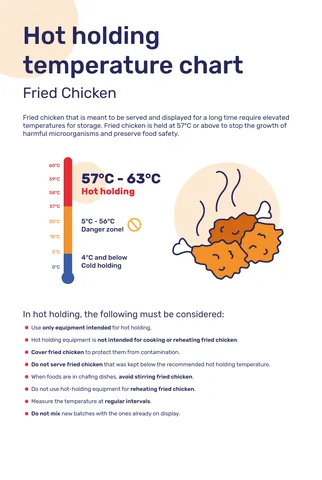
Free Fried Chicken Hot Holding Temp Guide
Free UK guide on hot holding temperature for fried chicken. Learn statutory 63°C limits, heated display cabinets, probe monitoring, and food safety rules.
The statutory minimum hot holding temperature for fried chicken in the UK is 63°C (145°F) under the Food Safety and Hygiene Regulations 2013. Prior to hot holding in display warmers or pass-through chutes, fried chicken must reach a cooked core temperature of at least 75°C (82°C in Scotland) to eliminate Salmonella and Campylobacter.
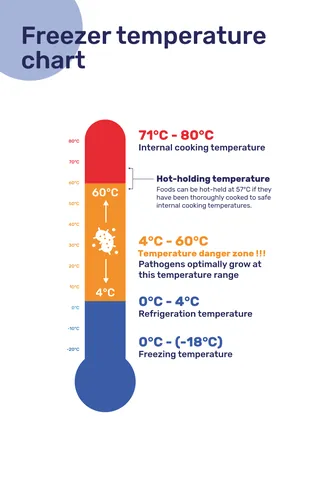
UK Master Food Temperature Danger Zone & Storage Chart
Explore the statutory UK commercial kitchen food temperature hierarchy. Inspect legal cold holding limits (≤5°C / 8°C), the 8°C–63°C Danger Zone, hot holding rules (≥63°C), and cooking lethality (75°C / 82°C Scotland).
FSA Safe Cooking & Core Thermal Lethality (UK General) - Scientific Impact
Critical Control Point (CCP). Achieves instantaneous 6-log (99.9999%) reduction of Salmonella, Campylobacter, and Listeria within 30 seconds.
Statutory Commercial Kitchen Temperature Hierarchy
| Stage / Appliance | Standard Target (°C) | Statutory Legal Limit | Audit Frequency | Key Bacterial Hazard |
|---|---|---|---|---|
| Commercial Deep Freezer | -18°C or colder | ≤ -18°C (Brief -15°C defrost) | Twice daily (AM/PM) | All growth halted / dormant |
| Walk-in Chiller / Prep Fridge | 1°C to 5°C | Legal max 8.0°C (England/Wales) | Twice daily (AM/PM) | Listeria monocytogenes |
| Temperature Danger Zone | 8°C to 63°C | STRICTLY PROHIBITED | Continuous monitoring | Rapid Salmonella & E. coli growth |
| Hot-Holding Buffet / Pass | ≥ 63°C | ≥ 63.0°C (Max 2h exemption) | Every 2 hours during service | Clostridium perfringens |
| Cooking Core (UK General) | ≥ 75°C for 30s | 75°C (30s) / 70°C (2m) | Every cook batch | Campylobacter & Salmonella lethality |
| Scottish Cooking & Reheating | ≥ 82°C instant | 82.0°C statutory requirement | Every reheat batch | Destruction of bacterial toxins |
| Rapid Blast Chilling | 63°C down to 8°C in 90m | Within 90 mins max | Every cooked cooled batch | Bacillus cereus spore germination |
| Dishwasher Sanitising Rinse | ≥ 82°C | BS EN 1276 thermal disinfection | Daily temperature strip test | Surface cross-contamination removal |
MASTER FOOD TEMPERATURE CHART
Food Safety Act 1990 • Food Hygiene Regulations • SFBB HACCP Standard
Cold Chain & Storage Controls
Hot Holding & Cooking Lethality
Bacteria multiply exponentially between 8°C and 63°C, peaking at 37°C. High-risk foods must NEVER be kept in this zone without documented time-exemption protocols. Hot food falling below 63°C must be eaten or thrown away within 2 hours.
How to Implement the Hot Holding Temperature For Fried Chicken in Your Commercial Kitchen
Practical due diligence procedures, regulatory compliance steps, and EHO audit verification guidelines for UK hospitality businesses.
UK Statutory Due Diligence Framework
Under Section 21 of the Food Safety Act 1990, a food business operator has a defense of due diligence if they prove that all reasonable precautions were taken and all due diligence was exercised to prevent food safety offenses.
Documented logs like the Hot Holding Temperature For Fried Chicken provide contemporaneous proof of monitoring required by Regulation (EC) No 852/2004 (retained UK law). Local council Environmental Health Officers (EHO) evaluate these records when scoring the "Confidence in Management" category of the Food Hygiene Rating Scheme (FHRS).
Official FSA Record-Keeping Guidance & Due Diligence
Under UK Food Standards Agency (FSA) Safer Food, Better Business (SFBB) standards and Article 5 of Regulation (EC) No 852/2004, food business operators are required to maintain contemporaneous, accurate operational records.
- Contemporaneous logging: Kitchen logs must reflect actual checks performed during opening, active service, and closing rather than retrospective estimates.
- Corrective action logs: Whenever a critical limit is breached, document the specific corrective measure taken (e.g. food discarded, chilled, or reheated) with staff initials.
- Statutory due diligence defense: Retaining completed daily sheets for a minimum of 6 to 12 months supports the statutory defense under Section 21 of the Food Safety Act 1990. Official guidance is available at food.gov.uk.
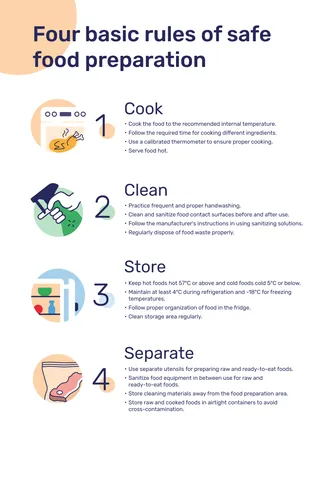
Step-by-Step Operational Routine
Operational Step 1
Deep fry chicken until thickest bone-adjacent meat reaches a minimum core temperature of 75°C (82°C in Scotland).
Operational Step 2
Transfer cooked chicken immediately to a preheated commercial holding cabinet set between 65°C and 70°C.
Operational Step 3
Audit holding temperatures hourly with a sanitised needle probe inserted into the thickest breast and thigh pieces.
Operational Step 4
Ensure holding chutes have controlled humidity to maintain crispy skin while preventing surface desiccation.
Operational Step 5
Enforce a strict maximum holding time (typically 90 minutes); discard unsold batches exceeding holding limits.
Procedures align with UK Food Standards Agency (FSA) Safer Food, Better Business (SFBB) catering guidance and the Food Information Regulations 2014. Review official advice at food.gov.uk.
Frequently Asked Questions
Common questions about UK kitchen compliance, record keeping, and EHO audits.
All temperatures, microbial lethality pairs, and critical limits on this page have been verified against primary statutory documents issued by the UK Food Standards Agency (FSA), Food Standards Scotland (FSS), Regulation (EC) No 852/2004, and US FDA/USDA guidelines.
These templates, checklists, and calculators are food-safety management tools designed to assist UK food business operators (FBOs) in maintaining organised kitchen records and internal procedures. They do not constitute legal advice and using them does not guarantee compliance with UK food law or a five-star food hygiene rating.
Commercial Kitchen Food Cooling & Temperature Limits Guide
Read our in-depth guidance on UK Food Standards Agency inspection procedures, staff training, and compliance routines.