 SMART TOOL
Free Food Product Specification Template
Free commercial food product specification template. QUID ingredient declarations, Natasha's Law allergens, microbial criteria, and printable QA sheets.
A commercial food product specification template defines the technical, legal, and safety standards for manufactured food items and catering preparations. Covering Quantitative Ingredient Declarations (QUID %), statutory 14-allergen declarations under Natasha's Law, microbiological process hygiene criteria under Regulation (EC) No 2073/2005, packaging barrier integrity, and shelf-life storage parameters.
Commercial Food Product Technical Specification Builder
Formulate compliant technical food specifications. Define Quantitative Ingredient Declarations (QUID %), flag statutory allergens under Natasha's Law, specify microbiological limits, and print an A4 Technical QA Dossier.
Formulation & Quantitative Ingredient Declaration (QUID %):
Total QUID: 100%| Ingredient Component | QUID % | Allergen Classification | Country of Origin |
|---|---|---|---|
| Diced British Beef Chuck Steak | 45% | No Allergen | United Kingdom |
| Red Wine Reduction Sauce (Contains Sulphites) | 25% | Sulphur dioxide/sulphites | France |
| Shallots & Button Mushrooms | 15% | No Allergen | United Kingdom |
| Rich Beef Stock (Beef Bones, Celery, Carrot, Onion) | 10% | Celery | United Kingdom |
| Unsalted Butter (Cow's Milk) | 3% | Milk | United Kingdom |
| Wheat Flour (for roux thickening) | 2% | Gluten (Wheat) | United Kingdom |
PRODUCT SPECIFICATION
Regulation (EU) No 1169/2011 • Natasha's Law (FIR 2021) • BRCGS Food Safety Issue 9
1. Ingredient Breakdown & Legal Label Declaration (QUID %)
Legal Ingredients List: Beef (45%), Red Wine Reduction Sauce (25%) [Red Wine (Sulphites), Water, Tomato Paste], Shallots, Mushrooms, Beef Stock (10%) [Water, Beef Bones, Celery, Carrots, Onions], Butter (3%) (Milk), Wheat Flour (2%) (Wheat Gluten), Salt, Black Pepper.
2. Microbiological Safety Criteria (Regulation EC No 2073/2005)
| Microorganism | Target Standard | Statutory Action Limit | Testing Frequency |
|---|---|---|---|
| Total Viable Count (TVC @ 30°C) | < 10^3 cfu/g | >= 10^5 cfu/g | Monthly swab testing |
| Enterobacteriaceae | < 10 cfu/g | >= 10^2 cfu/g | Each production run |
| Escherichia coli | < 10 cfu/g | >= 20 cfu/g | Each production run |
| Listeria monocytogenes | Absent in 25g | Detected in 25g | Shelf-life end testing |
| Salmonella enterica | Absent in 25g | Detected in 25g | Quarterly lab panel |
How to Implement the Product Specification Template in Your Commercial Kitchen
Practical due diligence procedures, regulatory compliance steps, and EHO audit verification guidelines for UK hospitality businesses.
UK Statutory Due Diligence Framework
Under Section 21 of the Food Safety Act 1990, a food business operator has a defense of due diligence if they prove that all reasonable precautions were taken and all due diligence was exercised to prevent food safety offenses.
Documented logs like the Product Specification Template provide contemporaneous proof of monitoring required by Regulation (EC) No 852/2004 (retained UK law). Local council Environmental Health Officers (EHO) evaluate these records when scoring the "Confidence in Management" category of the Food Hygiene Rating Scheme (FHRS).
Official FSA Record-Keeping Guidance & Due Diligence
Under UK Food Standards Agency (FSA) Safer Food, Better Business (SFBB) standards and Article 5 of Regulation (EC) No 852/2004, food business operators are required to maintain contemporaneous, accurate operational records.
- Contemporaneous logging: Kitchen logs must reflect actual checks performed during opening, active service, and closing rather than retrospective estimates.
- Corrective action logs: Whenever a critical limit is breached, document the specific corrective measure taken (e.g. food discarded, chilled, or reheated) with staff initials.
- Statutory due diligence defense: Retaining completed daily sheets for a minimum of 6 to 12 months supports the statutory defense under Section 21 of the Food Safety Act 1990. Official guidance is available at food.gov.uk.
Step-by-Step Operational Routine
Operational Step 1
Document finished product identity: brand, SKU code, net weight, production facility, and target customer demographic.
Operational Step 2
Formulate ingredients list with precise Quantitative Ingredient Declarations (QUID %) for highlighted characterising ingredients.
Operational Step 3
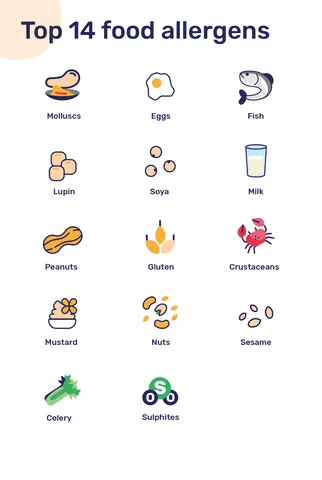
Highlight all 14 statutory allergens in bold text in compliance with Natasha's Law (Food Information Regulations 2021).
Operational Step 4
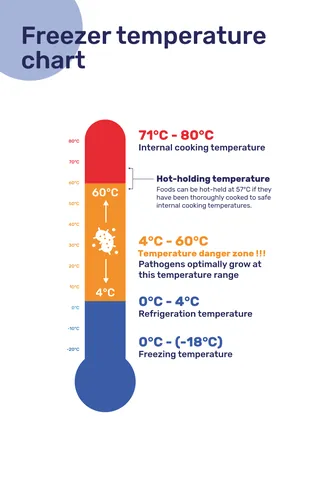
Set validated microbiological action thresholds (Enterobacteriaceae, E. coli, Salmonella, Listeria) based on shelf-life testing.
Operational Step 5
Archive the technical specification dossier in the QA management database for annual audit review.
Procedures align with UK Food Standards Agency (FSA) Safer Food, Better Business (SFBB) catering guidance and the Food Information Regulations 2014. Review official advice at food.gov.uk.
Frequently Asked Questions
Common questions about UK kitchen compliance, record keeping, and EHO audits.
All temperatures, microbial lethality pairs, and critical limits on this page have been verified against primary statutory documents issued by the UK Food Standards Agency (FSA), Food Standards Scotland (FSS), Regulation (EC) No 852/2004, and US FDA/USDA guidelines.
These templates, checklists, and calculators are food-safety management tools designed to assist UK food business operators (FBOs) in maintaining organised kitchen records and internal procedures. They do not constitute legal advice and using them does not guarantee compliance with UK food law or a five-star food hygiene rating.
How to Scale Recipes for Commercial Catering: Batch Calculator
Read our in-depth guidance on UK Food Standards Agency inspection procedures, staff training, and compliance routines.