 POSTER
Free Kitchen Food Cooling Poster UK
Download a free kitchen wall poster explaining the UK 90-minute cooling rule, blast chilling, and danger zone temperature limits for safe catering.
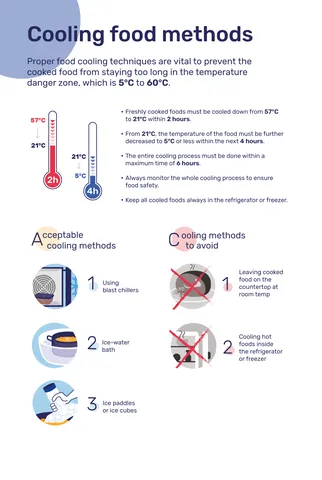
A commercial food cooling poster provides standard operating instructions for the UK 90-minute cooling rule, shallow pan division, and blast chilling protocols. Cooling hot cooked food to 8°C or colder within 90 minutes prevents Bacillus cereus and Clostridium perfringens spore germination in catering environments.
Commercial Kitchen Food Cooling Standard & Rapid Chill Tracker
Log hot batch cooling cycles in real time, verify compliance with the statutory 90-minute limit (from 63°C to ≤ 8°C), and print an EHO-compliant kitchen wall poster with emergency corrective action protocols.
Target: Reduce hot food (> 63°C) to ambient (< 21°C) within 45 mins, then < 8°C within 90 mins total.
Statutory 2-Stage Cooling Milestones (FSA SFBB)
Decant into shallow pans (< 5cm). Immerse bases in ice baths or position under extraction fans. Cover loosely to vent steam.
Transfer to blast chiller or dedicated cooling fridge. Seal airtight once cooled and apply dated shelf-life label.
Simulate / Log Food Batch Cooling Cycle
EHO Due Diligence Evidence| Dish Name | Start Temp | Start Time | Final Temp | Total Mins | Compliance Status | Action |
|---|---|---|---|---|---|---|
| Slow-Cooked Beef Chilli | 86°C | 14:15 | 4.8°C | 75 min | PASS (≤ 90m to ≤ 8°C) | |
| Rich Chicken Stock / Jus | 92°C | 15:00 | 5.2°C | 85 min | PASS (≤ 90m to ≤ 8°C) |
Commercial Kitchen Food Cooling Rules & 90-Minute Limit
Mandatory Cooling Timelines, Spore Prevention & Corrective Action Protocol
The Statutory 90-Minute Cooling Timeline
Immediately record finish cooking temperature (≥ 75°C). Never leave food in deep cooking pots or stock kettles.
Decant into shallow stainless gastronorm pans (< 5cm depth). Immerse pan in ice water bath. Stir with clean sanitised probe paddle.
Transfer pans to commercial blast chiller or top shelf of dedicated chilling unit. Verify core reaches ≤ 8°C, cover airtight, and label.
5 Approved Commercial Rapid Cooling Methods (FSA SFBB)
Never exceed 5cm food depth. Spreading stews and curries across shallow metal pans multiplies surface area for rapid heat loss.
Place shallow pans inside a larger sink or tub filled with 50% ice and 50% cold water. Stir continuously with a disinfected spoon.
Whole roasts (beef, pork, turkey) retain internal heat. Slice or divide whole roasts into smaller cuts under 2.5kg before chilling.
Utilise certified blast chiller cycles engineered to lower temperatures from +70°C to +3°C within 90 minutes with high-velocity cold airflow.
For concentrated stocks, soups, and gravies, prepare as a reduction and top up with ice-cold potable water at the end of boiling.
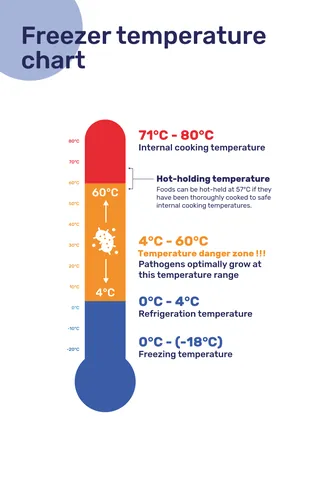
Never place deep pots of steaming hot food directly into regular storage fridges. This warms up adjacent food into the Danger Zone.
If food is still above 8°C after 2 hours: Spore-forming pathogens (Clostridium perfringens) will have germinated. If discovered within 2 hours, immediately re-heat throughout to ≥ 75°C (82°C in Scotland) for 30 seconds and restart cooling with shallow pans.
If food has been in Danger Zone (> 8°C) for over 4 hours: REHEATING IS STRICTLY PROHIBITED. Bacterial heat-stable enterotoxins (Bacillus cereus) cannot be destroyed by boiling. Immediately discard into Category 3 waste and log in the SFBB Diary.
How to Implement the Food Cooling Methods & Two-Stage Chilling Poster in Your Commercial Kitchen
Practical due diligence procedures, regulatory compliance steps, and EHO audit verification guidelines for UK hospitality businesses.
UK Statutory Due Diligence Framework
Under Section 21 of the Food Safety Act 1990, a food business operator has a defense of due diligence if they prove that all reasonable precautions were taken and all due diligence was exercised to prevent food safety offenses.
Documented logs like the Food Cooling Methods & Two-Stage Chilling Poster provide contemporaneous proof of monitoring required by Regulation (EC) No 852/2004 (retained UK law). Local council Environmental Health Officers (EHO) evaluate these records when scoring the "Confidence in Management" category of the Food Hygiene Rating Scheme (FHRS).
Official FSA Record-Keeping Guidance & Due Diligence
Under UK Food Standards Agency (FSA) Safer Food, Better Business (SFBB) standards and Article 5 of Regulation (EC) No 852/2004, food business operators are required to maintain contemporaneous, accurate operational records.
- Contemporaneous logging: Kitchen logs must reflect actual checks performed during opening, active service, and closing rather than retrospective estimates.
- Corrective action logs: Whenever a critical limit is breached, document the specific corrective measure taken (e.g. food discarded, chilled, or reheated) with staff initials.
- Statutory due diligence defense: Retaining completed daily sheets for a minimum of 6 to 12 months supports the statutory defense under Section 21 of the Food Safety Act 1990. Official guidance is available at food.gov.uk.
Step-by-Step Operational Routine
Operational Step 1
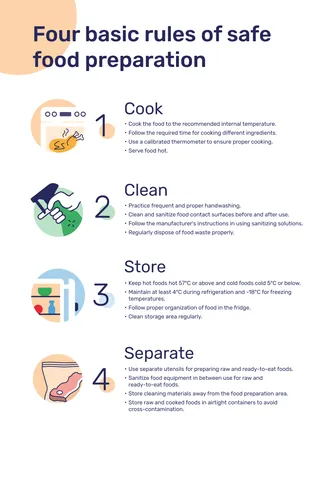
Portion hot cooked batches into clean, shallow stainless steel gastro trays (maximum 5cm depth).
Operational Step 2
Place trays in well-ventilated areas or ice baths to accelerate temperature reduction.
Operational Step 3
Use an automated blast chiller when available to drive core temperatures below 8°C within 90 minutes.
Operational Step 4
Probe and log core temperatures at 30 minutes, 60 minutes, and 90 minutes on your cooling record.
Operational Step 5
Cover, date-code, and transfer chilled food into walk-in refrigeration once reaching 8°C.
Procedures align with UK Food Standards Agency (FSA) Safer Food, Better Business (SFBB) catering guidance and the Food Information Regulations 2014. Review official advice at food.gov.uk.
Frequently Asked Questions
Common questions about UK kitchen compliance, record keeping, and EHO audits.
All temperatures, microbial lethality pairs, and critical limits on this page have been verified against primary statutory documents issued by the UK Food Standards Agency (FSA), Food Standards Scotland (FSS), Regulation (EC) No 852/2004, and US FDA/USDA guidelines.
These templates, checklists, and calculators are food-safety management tools designed to assist UK food business operators (FBOs) in maintaining organised kitchen records and internal procedures. They do not constitute legal advice and using them does not guarantee compliance with UK food law or a five-star food hygiene rating.
Commercial Kitchen Food Cooling & Temperature Limits Guide
Read our in-depth guidance on UK Food Standards Agency inspection procedures, staff training, and compliance routines.