 POSTER
Free 5 Key Food Safety Rules Poster
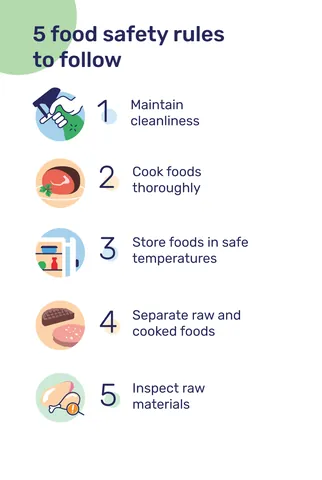
World Health Organisation 5 keys to safer food reference poster for staff training. Covers cleanliness, separation, cooking, temperature, and safe water.
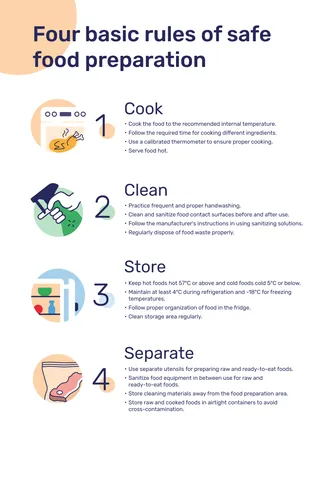
The five essential food safety rules summarize the core hygiene principles established by the World Health Organization and UK Food Standards Agency: keep clean, separate raw and cooked, cook thoroughly, keep food at safe temperatures, and use safe water and raw materials. Displaying these rules builds staff hygiene discipline.
UK Commercial Kitchen Food Preparation Rules Poster & Station SOP
Customise your kitchen food preparation guidelines by specific culinary station, select legal jurisdiction temperature thresholds, and complete the pre-service shift audit before generating an A4 printable wall poster.
Pre-Service Kitchen Readiness Audit Checklist
Click items below as completed before staff begin active culinary prep.
Master Kitchen Standard (All Stations)
Mandatory Operational Hygiene, Temperature Limits & Cross-Contamination Barriers
Station Critical Operating Rules (Mandatory Compliance)
Station Standard: Ambient prep < 20 minutes before returning to cold chain (< 8°C)Rigorous 20-Second Handwashing
Wash forearms and hands at designated basins before handling food, after raw contact, touching waste, or using the WC.
Strict Colour-Coded Separation
Never use the same board or knife for raw meats and ready-to-eat produce without full 2-stage chemical disinfection.
Two-Stage Cleaning & Disinfection
Stage 1: Detergent wash to strip grease. Stage 2: Disinfectant spray with certified chemical meeting BS EN 1276.
Clear FIFO Date Labelling
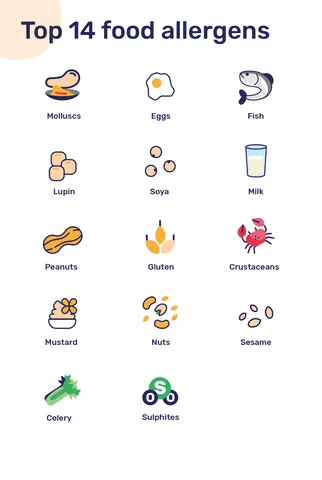
Every prepped pan, gastronorm, and vacuum bag must carry prep date, discard date, and allergenic ingredients.
FSA 4 Cs Food Hygiene Pillar Matrix
2-stage method: detergent wipe to remove grease, then certified BS EN 1276 sanitiser with full contact time.
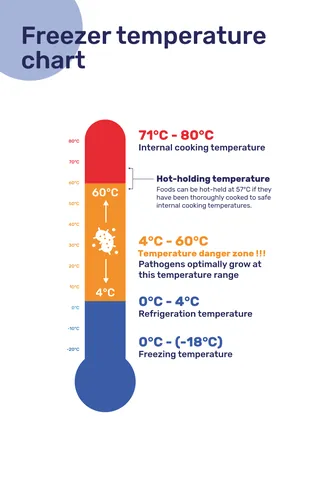
Core temperature ≥ 75°C for 30s (82°C in Scotland). Probe centre of thickest cut with disinfected probe.
Cool hot cooked foods to < 8°C within 90 minutes. Keep chillers between 1°C and 5°C (legal max 8°C).
Strict colour-coded boards, bottom-shelf raw storage, 20s handwash, and dedicated allergen-safe zones.
Mandatory Protective Clothing & PPE
- Clean laundered apron
- Hairnet / beard snood
- Blue detectable plaster for minor cuts
- Zero watch or jewellery (plain band only)
Statutory Exclusion & Health Rules
- 48-Hour Exclusion: Staff with vomiting/diarrhoea must stay off duty for 48h after symptoms cease.
- Blue Detectable Plasters: All cuts/burns must be dressed with metal-detectable blue waterproof plasters.
- Zero Cross-Contact: Single-use probe wipes must be used between every temperature probe insertion.
How to Implement the 5 Food Safety Rules in Your Commercial Kitchen
Practical due diligence procedures, regulatory compliance steps, and EHO audit verification guidelines for UK hospitality businesses.
UK Statutory Due Diligence Framework
Under Section 21 of the Food Safety Act 1990, a food business operator has a defense of due diligence if they prove that all reasonable precautions were taken and all due diligence was exercised to prevent food safety offenses.
Documented logs like the 5 Food Safety Rules provide contemporaneous proof of monitoring required by Regulation (EC) No 852/2004 (retained UK law). Local council Environmental Health Officers (EHO) evaluate these records when scoring the "Confidence in Management" category of the Food Hygiene Rating Scheme (FHRS).
Official FSA Record-Keeping Guidance & Due Diligence
Under UK Food Standards Agency (FSA) Safer Food, Better Business (SFBB) standards and Article 5 of Regulation (EC) No 852/2004, food business operators are required to maintain contemporaneous, accurate operational records.
- Contemporaneous logging: Kitchen logs must reflect actual checks performed during opening, active service, and closing rather than retrospective estimates.
- Corrective action logs: Whenever a critical limit is breached, document the specific corrective measure taken (e.g. food discarded, chilled, or reheated) with staff initials.
- Statutory due diligence defense: Retaining completed daily sheets for a minimum of 6 to 12 months supports the statutory defense under Section 21 of the Food Safety Act 1990. Official guidance is available at food.gov.uk.
Step-by-Step Operational Routine
Operational Step 1
Display this poster at main kitchen entryways, staff locker rooms, and primary prep areas.
Operational Step 2
Review the five principles with every new culinary hire during initial onboarding training.
Operational Step 3
Verify daily that washbasins have antibacterial soap and single-use disposable blue paper towels.
Operational Step 4
Ensure food probes are calibrated monthly and records are documented in your safety log.
Operational Step 5
Inspect supplier deliveries to confirm food is fresh, properly chilled, and within use-by dates.
Procedures align with UK Food Standards Agency (FSA) Safer Food, Better Business (SFBB) catering guidance and the Food Information Regulations 2014. Review official advice at food.gov.uk.
Frequently Asked Questions
Common questions about UK kitchen compliance, record keeping, and EHO audits.
All temperatures, microbial lethality pairs, and critical limits on this page have been verified against primary statutory documents issued by the UK Food Standards Agency (FSA), Food Standards Scotland (FSS), Regulation (EC) No 852/2004, and US FDA/USDA guidelines.
These templates, checklists, and calculators are food-safety management tools designed to assist UK food business operators (FBOs) in maintaining organised kitchen records and internal procedures. They do not constitute legal advice and using them does not guarantee compliance with UK food law or a five-star food hygiene rating.
UK Food Hygiene Rating Scheme: Complete 5-Star Inspection Checklist
Read our in-depth guidance on UK Food Standards Agency inspection procedures, staff training, and compliance routines.