 SMART TOOL
Free Consumer Advisory Notice Template
Free UK restaurant consumer advisory notice template. Display statutory warnings for raw shellfish, rare steaks, and pink meat to meet EHO standards.
A commercial consumer advisory notice informs restaurant diners and takeaway customers of the health risks associated with consuming raw, undercooked, or lightly cooked foods (such as rare steaks, raw bivalve molluscs/oysters, pink duck breast, runny eggs, and unpasteurised cheeses). Fulfilling due diligence requirements under the Food Safety Act 1990 and UK Food Standards Agency guidelines.
Commercial Consumer Advisory Notice & Signage Builder
Generate an official UK restaurant consumer advisory notice for raw, undercooked, or lightly cooked foods. Customise food hazard disclosures, meet local authority EHO due diligence requirements, and print laminated A4/A5 display cards.
Rare & Medium-Rare Intact Beef & Steaks
Serving whole muscle beef rare carries risk if exterior surfaces are not thoroughly seared. Minced beef/burgers must NEVER be served rare without FSA-approved validation.
Raw Oysters & Live Bivalve Molluscs
Raw oysters may carry Norovirus, Vibrio vulnificus, and marine biotoxins. Filter feeders concentrate microbial pathogens.
Seared Pink Duck Breast Fillets
Duck breast served medium or pink carries potential risk of Campylobacter and Salmonella if whole muscle integrity is compromised.
Raw & Lightly Cooked British Lion Eggs
Non-Lion or uncertified eggs carry Salmonella enteritidis contamination risks when served raw, runny, or in unbaked desserts.
Ceviche, Tartare & Cold-Smoked Fish
Raw or lightly marinated wild finfish carries risks of live Anisakis simplex nematode larvae and Listeria monocytogenes.
Artisan Raw Milk & Unpasteurised Cheeses
Unpasteurised dairy products may harbor Listeria monocytogenes, E. coli O157, and Mycobacterium bovis.
CONSUMER ADVISORY NOTICE
The Metropolitan Bistro & Grill • Food Safety Act 1990 Due Diligence Compliance
Consuming raw or undercooked meats, poultry, seafood, shellfish, or eggs may increase your risk of foodborne illness, especially if you have certain medical conditions. Please inform your server of any dietary requirements, allergies, or intolerances before ordering.
Menu Items Prepared to Order with Less Thorough Cooking:
The Food Standards Agency (FSA) strongly advises that vulnerable individuals—including pregnant women, the elderly, infants, young children, and those with weakened immune systems—should avoid consuming raw shellfish, rare meats, or unpasteurised dairy products.
How to Implement the Consumer Advisory in Your Commercial Kitchen
Practical due diligence procedures, regulatory compliance steps, and EHO audit verification guidelines for UK hospitality businesses.
UK Statutory Due Diligence Framework
Under Section 21 of the Food Safety Act 1990, a food business operator has a defense of due diligence if they prove that all reasonable precautions were taken and all due diligence was exercised to prevent food safety offenses.
Documented logs like the Consumer Advisory provide contemporaneous proof of monitoring required by Regulation (EC) No 852/2004 (retained UK law). Local council Environmental Health Officers (EHO) evaluate these records when scoring the "Confidence in Management" category of the Food Hygiene Rating Scheme (FHRS).
Official FSA Record-Keeping Guidance & Due Diligence
Under UK Food Standards Agency (FSA) Safer Food, Better Business (SFBB) standards and Article 5 of Regulation (EC) No 852/2004, food business operators are required to maintain contemporaneous, accurate operational records.
- Contemporaneous logging: Kitchen logs must reflect actual checks performed during opening, active service, and closing rather than retrospective estimates.
- Corrective action logs: Whenever a critical limit is breached, document the specific corrective measure taken (e.g. food discarded, chilled, or reheated) with staff initials.
- Statutory due diligence defense: Retaining completed daily sheets for a minimum of 6 to 12 months supports the statutory defense under Section 21 of the Food Safety Act 1990. Official guidance is available at food.gov.uk.
Step-by-Step Operational Routine
Operational Step 1
Identify menu items served raw or less thoroughly cooked: whole muscle steaks (rare/medium-rare), oysters, carpaccio, tartare, runny eggs, or pink poultry.
Operational Step 2
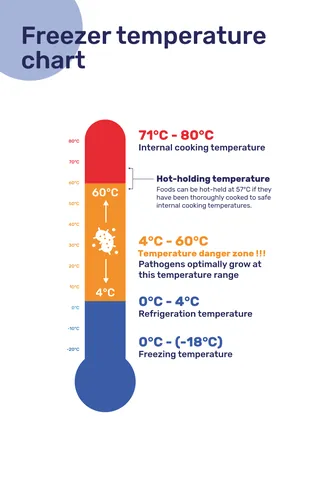
Verify that whole muscle cuts have surfaces seared to at least 75°C to eliminate surface bacteria, and sushi-grade fish has verified parasite freezing certificates.
Operational Step 3
Prominently display the statutory consumer advisory statement on all printed menus, digital ordering websites, and front-of-house service counters.
Operational Step 4
Train front-of-house staff to highlight the consumer advisory to vulnerable individuals (elderly guests, pregnant women, and immunocompromised diners).
Procedures align with UK Food Standards Agency (FSA) Safer Food, Better Business (SFBB) catering guidance and the Food Information Regulations 2014. Review official advice at food.gov.uk.
Frequently Asked Questions
Common questions about UK kitchen compliance, record keeping, and EHO audits.
All temperatures, microbial lethality pairs, and critical limits on this page have been verified against primary statutory documents issued by the UK Food Standards Agency (FSA), Food Standards Scotland (FSS), Regulation (EC) No 852/2004, and US FDA/USDA guidelines.
These templates, checklists, and calculators are food-safety management tools designed to assist UK food business operators (FBOs) in maintaining organised kitchen records and internal procedures. They do not constitute legal advice and using them does not guarantee compliance with UK food law or a five-star food hygiene rating.
Commercial Kitchen Food Cooling & Temperature Limits Guide
Read our in-depth guidance on UK Food Standards Agency inspection procedures, staff training, and compliance routines.