 POSTER
Free Chopping Board Colour Chart
Printable colour-coded cutting board wall poster for UK food businesses. Prevent cross-contamination between raw meat, poultry, fish, and salads.
A UK colour-coded chopping board chart establishes standard culinary colour assignments to prevent cross-contamination between raw proteins, cooked meats, vegetables, and allergen-free preparations. Displaying this chart and training staff on board separation is a fundamental requirement for passing UK Environmental Health Officer inspections.
Commercial Chopping Board Colour Chart & Food Classifier
Eliminate cross-contamination in your kitchen brigade. Look up any culinary ingredient to instantly identify its designated board colour, review microbial risk controls, and print a high-contrast A4 wall reference chart.
UK Chopping Board Colour Coding Chart
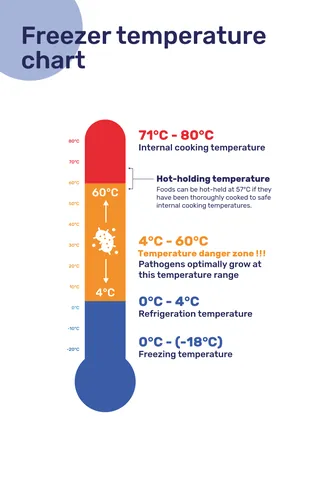
Strict board segregation prevents cross-contamination. Always wash and sanitise boards through a commercial dishwasher operating at ≥82°C rinse.
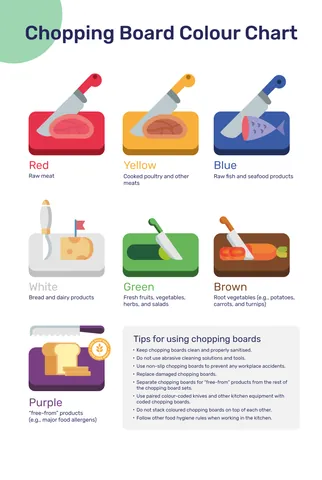
Raw red meat, raw beef, pork, lamb, minced meat, raw poultry and game birds.
Raw fish fillets, whole fish, prawns, squid, shellfish, and crustaceans.
Pre-cooked sliced meats, roast joints, cooked chicken breasts, cured charcuterie.
Washed salad greens, ready-to-eat raw vegetables, fruit, garnishes, and fresh herbs.
Unwashed root crops, soil-grown vegetables, and unpeeled tubers before scrubbing.
Bread loaves, burger buns, sliced block cheese, bakery doughs, cakes, and dairy.
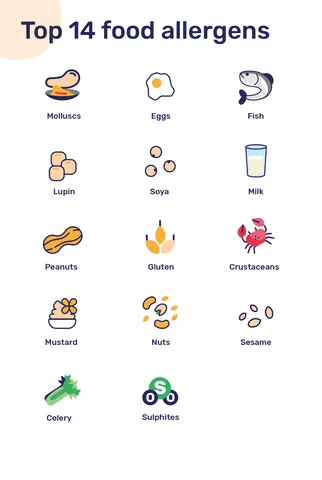
Dedicated allergen-free orders, coeliac gluten-free prep, and nut-safe meal production.
- Board Wear & Grooves: Replace plastic cutting boards immediately once deep knife grooves appear. Bacteria multiply in knife cuts where sanitisers cannot reach.
- Thermal Disinfection: Wash in a commercial pass-through dishwasher with wash temp ≥60°C and final rinse ≥82°C.
- Storage Racks: Store clean chopping boards in vertical stainless-steel drying racks with air circulation. Never stack wet boards flat.
How to Implement the UK Chopping Board Colour Chart in Your Commercial Kitchen
Practical due diligence procedures, regulatory compliance steps, and EHO audit verification guidelines for UK hospitality businesses.
UK Statutory Due Diligence Framework
Under Section 21 of the Food Safety Act 1990, a food business operator has a defense of due diligence if they prove that all reasonable precautions were taken and all due diligence was exercised to prevent food safety offenses.
Documented logs like the UK Chopping Board Colour Chart provide contemporaneous proof of monitoring required by Regulation (EC) No 852/2004 (retained UK law). Local council Environmental Health Officers (EHO) evaluate these records when scoring the "Confidence in Management" category of the Food Hygiene Rating Scheme (FHRS).
Official FSA Record-Keeping Guidance & Due Diligence
Under UK Food Standards Agency (FSA) Safer Food, Better Business (SFBB) standards and Article 5 of Regulation (EC) No 852/2004, food business operators are required to maintain contemporaneous, accurate operational records.
- Contemporaneous logging: Kitchen logs must reflect actual checks performed during opening, active service, and closing rather than retrospective estimates.
- Corrective action logs: Whenever a critical limit is breached, document the specific corrective measure taken (e.g. food discarded, chilled, or reheated) with staff initials.
- Statutory due diligence defense: Retaining completed daily sheets for a minimum of 6 to 12 months supports the statutory defense under Section 21 of the Food Safety Act 1990. Official guidance is available at food.gov.uk.
Step-by-Step Operational Routine
Operational Step 1
Mount this chart directly above cutting board racks at central kitchen food preparation stations.
Operational Step 2
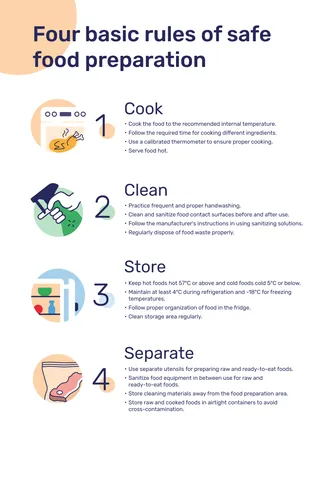
Use RED boards exclusively for raw meat and poultry.
Operational Step 3
Use BLUE boards for raw fish and seafood; YELLOW for cooked sliced meats.
Operational Step 4
Use GREEN for washed salads and fruit; BROWN for unwashed root vegetables; WHITE for dairy and bakery.
Operational Step 5
Scrape, wash with hot detergent, and sanitise boards in commercial dishwashers operating at >=82°C.
Procedures align with UK Food Standards Agency (FSA) Safer Food, Better Business (SFBB) catering guidance and the Food Information Regulations 2014. Review official advice at food.gov.uk.
Frequently Asked Questions
Common questions about UK kitchen compliance, record keeping, and EHO audits.
All temperatures, microbial lethality pairs, and critical limits on this page have been verified against primary statutory documents issued by the UK Food Standards Agency (FSA), Food Standards Scotland (FSS), Regulation (EC) No 852/2004, and US FDA/USDA guidelines.
These templates, checklists, and calculators are food-safety management tools designed to assist UK food business operators (FBOs) in maintaining organised kitchen records and internal procedures. They do not constitute legal advice and using them does not guarantee compliance with UK food law or a five-star food hygiene rating.
UK Food Hygiene Rating Scheme: Complete 5-Star Inspection Checklist
Read our in-depth guidance on UK Food Standards Agency inspection procedures, staff training, and compliance routines.