 CHART
Free Beef Cooking Temperature Chart
Free beef temperature chart for UK commercial kitchens. Rare, medium, and well-done core limits with mandatory 75°C cooking rules for minced burgers.
A commercial beef cooking temperature chart details the core thermal standards for beef cuts, differentiating between intact whole muscle roasts and ground minced beef. Under UK Food Standards Agency rules, whole steaks and roasts may be served rare (52°C–55°C) if all outer surfaces are seared, whereas minced beef burgers and rolled joints must achieve 75°C core for 30 seconds (82°C in Scotland).
Commercial British Beef Cooking Temperature & Core Probe Calculator
Calculate commercial roasting times by joint weight, inspect cut-specific core probe locations, verify compliance with statutory temperature limits (75°C for 30s / 82°C Scotland), and print an EHO audit wall chart.
Oven: 54.4°C - 63°C Precision Water Bath
Plus mandatory 5 min rest under foil to equalise core temperature.
Hold reading for at least 30 seconds at the thermal centre.
Commercial British Beef Cooking Temperature Chart
Whole Muscle vs Minced Beef Critical Boundaries • Statutory Core Probing & Carvery Holding Standards
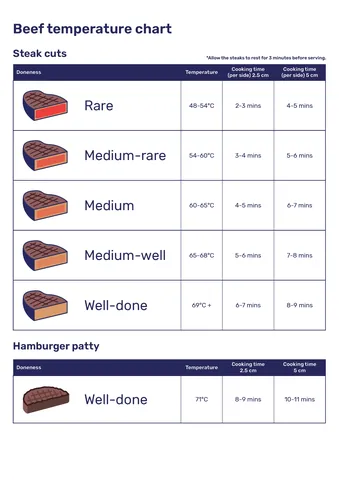
| Joint / Cut | Oven Temp | Time / kg | Resting | Min Core Temp | Probe Location Protocol |
|---|---|---|---|---|---|
Low-Temp Meat Pasteurisation (Sous-Vide & Precision Cooking) 6.5D/7D Thermal Destruction | 54.4°C - 63°C Precision Water Bath | 70 min/kg | 5 min | ≥ 55°C | Needle probe into the absolute geometric center of meat joint or vacuum pouch with closed-cell neoprene foam tape. |
Whole Ribeye / Sirloin Joint (Medium-Rare) Intact Whole Muscle | 220°C high sear (20m), then 160°C | 30 min/kg | 20 min | ≥ 54°C | Probe thermal center of joint after full searing of all external surfaces. |
Whole Topside / Striploin Joint (Medium) Intact Whole Muscle | 170°C – 180°C (Fan) | 38 min/kg | 20 min | ≥ 60°C | Center of thickest muscle mass. |
Rolled & Tied Beef Brisket / Rib Joint Rolled / Non-Intact | 150°C – 160°C Low & Slow | 50 min/kg | 20 min | ≥ 75°C | Probe geometrical core of the roll. |
Minced Beef Burgers & Patties Minced Meat | Griddle / Char-grill 200°C | 15 min/kg | 5 min | ≥ 75°C | Probe core of burger patty horizontally; verify reading holds for 30 seconds. |
Antibacterial Probe Hygiene
Always sanitise the digital thermometer probe with a single-use BS EN 1276 probe wipe before and immediately after checking each joint. Never insert an unwashed probe into cooked meats.
Mandatory 30-Second Dwell Time
Thermal lethality depends on time and temperature combinations. Hold the probe at the geometric center for at least 30 seconds to verify temperature stabilizes at or above the target limit before recording.
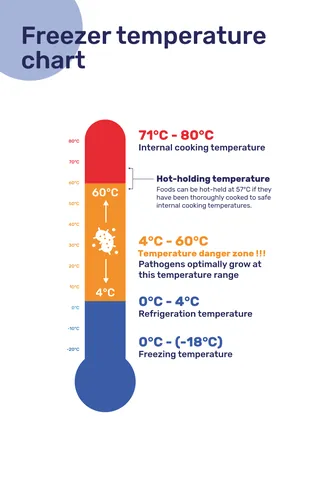
Service Hot-Holding (≥ 63°C)
Carvery decks, bain-maries, and heated passes must maintain cooked meats at ≥ 63°C continuously. If temperature drops below 63°C, the food must be consumed or discarded within 2 hours under UK law.
FSA 90-Minute Cooling Rule
Portion leftover cooked roasts into shallow stainless gastronorm pans (< 5cm depth). Chill down to < 8°C within 90 minutes before sealing and placing on top shelves of the walk-in refrigerator.
How to Implement the Beef Temperature Chart in Your Commercial Kitchen
Practical due diligence procedures, regulatory compliance steps, and EHO audit verification guidelines for UK hospitality businesses.
UK Statutory Due Diligence Framework
Under Section 21 of the Food Safety Act 1990, a food business operator has a defense of due diligence if they prove that all reasonable precautions were taken and all due diligence was exercised to prevent food safety offenses.
Documented logs like the Beef Temperature Chart provide contemporaneous proof of monitoring required by Regulation (EC) No 852/2004 (retained UK law). Local council Environmental Health Officers (EHO) evaluate these records when scoring the "Confidence in Management" category of the Food Hygiene Rating Scheme (FHRS).
Official FSA Record-Keeping Guidance & Due Diligence
Under UK Food Standards Agency (FSA) Safer Food, Better Business (SFBB) standards and Article 5 of Regulation (EC) No 852/2004, food business operators are required to maintain contemporaneous, accurate operational records.
- Contemporaneous logging: Kitchen logs must reflect actual checks performed during opening, active service, and closing rather than retrospective estimates.
- Corrective action logs: Whenever a critical limit is breached, document the specific corrective measure taken (e.g. food discarded, chilled, or reheated) with staff initials.
- Statutory due diligence defense: Retaining completed daily sheets for a minimum of 6 to 12 months supports the statutory defense under Section 21 of the Food Safety Act 1990. Official guidance is available at food.gov.uk.
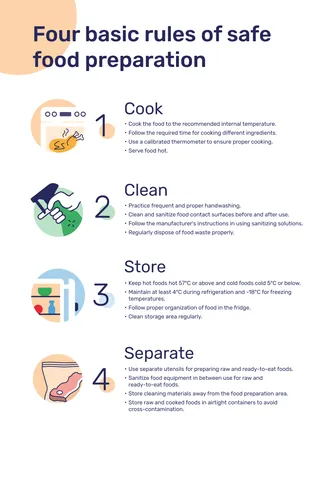
Step-by-Step Operational Routine
Operational Step 1
Distinguish between intact whole muscle cuts (steaks, roasts) and non-intact meats (mince, rolled joints).
Operational Step 2
Sear all external surfaces of intact beef joints; internal core can be medium-rare (54°C) or medium (60°C).
Operational Step 3
All minced beef burgers, rolled briskets, and kebabs must strictly achieve 75°C core for 30 seconds.
Operational Step 4
Maintain cooked carvery beef joints on hot holding units at or above 63°C continuously.
Procedures align with UK Food Standards Agency (FSA) Safer Food, Better Business (SFBB) catering guidance and the Food Information Regulations 2014. Review official advice at food.gov.uk.
Frequently Asked Questions
Common questions about UK kitchen compliance, record keeping, and EHO audits.
All temperatures, microbial lethality pairs, and critical limits on this page have been verified against primary statutory documents issued by the UK Food Standards Agency (FSA), Food Standards Scotland (FSS), Regulation (EC) No 852/2004, and US FDA/USDA guidelines.
These templates, checklists, and calculators are food-safety management tools designed to assist UK food business operators (FBOs) in maintaining organised kitchen records and internal procedures. They do not constitute legal advice and using them does not guarantee compliance with UK food law or a five-star food hygiene rating.
Commercial Kitchen Food Cooling & Temperature Limits Guide
Read our in-depth guidance on UK Food Standards Agency inspection procedures, staff training, and compliance routines.